

2025 Hurricane Season Forecast to Exceed Long-Term Average With 17 Named Storms: EIA
The 2025 hurricane season is expected to bring 17 named storms, surpassing the 1991–2020 average of 14, according to a May 20 report published by the U.S. Energy Information Administration. During the 2025 Atlantic hurricane season, meteorologists are expecting between 13 to 18 named storms, including 3 to 6 storms with direct impacts on the U.S. An average hurricane season has 14 named storms, 7 hurricanes, and 3 major hurricanes, according to National Oceanic Atmospheric Association (NOAA).
Stronger hurricane seasons increase the risk of weather-related production outages in the U.S. oil industry. The NOAA reported 18 named storms during 2024, with 11 of these storms having wind speeds above 74 mph, categorizing them as hurricanes, whilst five had wind speeds of 111 mph or above, classifying them as major hurricanes. Five hurricanes made landfall in the U.S. (Helene, Beryl, Francine, Debby and Milton), with two storms (Milton and Helene) making landfall as major hurricanes. According to the NOAA, on average the hurricane season has 14 named storms, seven hurricanes and three major hurricanes. During the 2023 Atlantic hurricane season there were 20 named storms, with only one hurricane making land in the U.S. Storms during the 2023 Atlantic hurricane season had an insignificant impact on production in the U.S. oil and gas sectors.
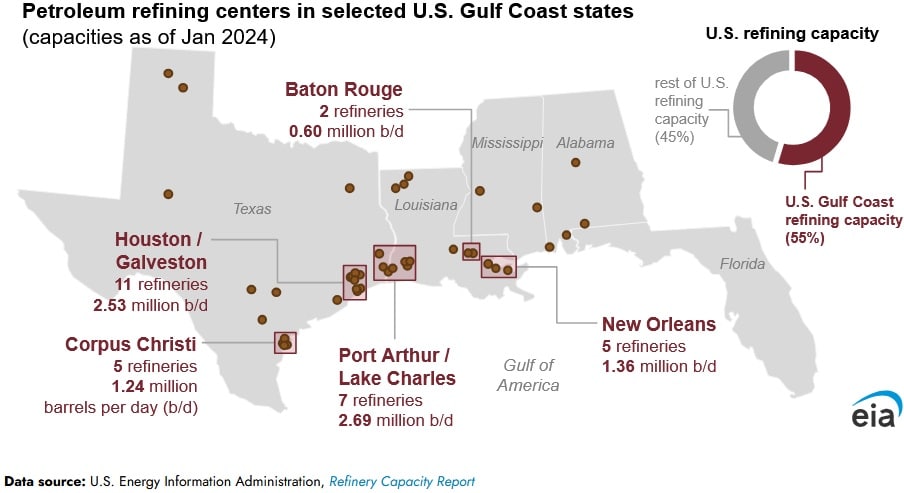
The U.S. Gulf Coast accounts for 55 percent of total U.S. refining capacity, with the Louisiana Gulf Coast and Texas Gulf Coast refining regions together accounting for 49 percent of the total capacity. These facilities are at risk of power outages or flooding associated with hurricanes or major storms. Refinery operators evacuate nonessential personnel and temporarily halt production when severe weather poses a risk to workers or facilities.
EnerKnol Pulses like this one are powered by the EnerKnol Platform—the first comprehensive database for real-time energy policy tracking. Sign up for a free trial below for access to key regulatory data and deep industry insights across the energy spectrum.
ACCESS FREE TRIAL