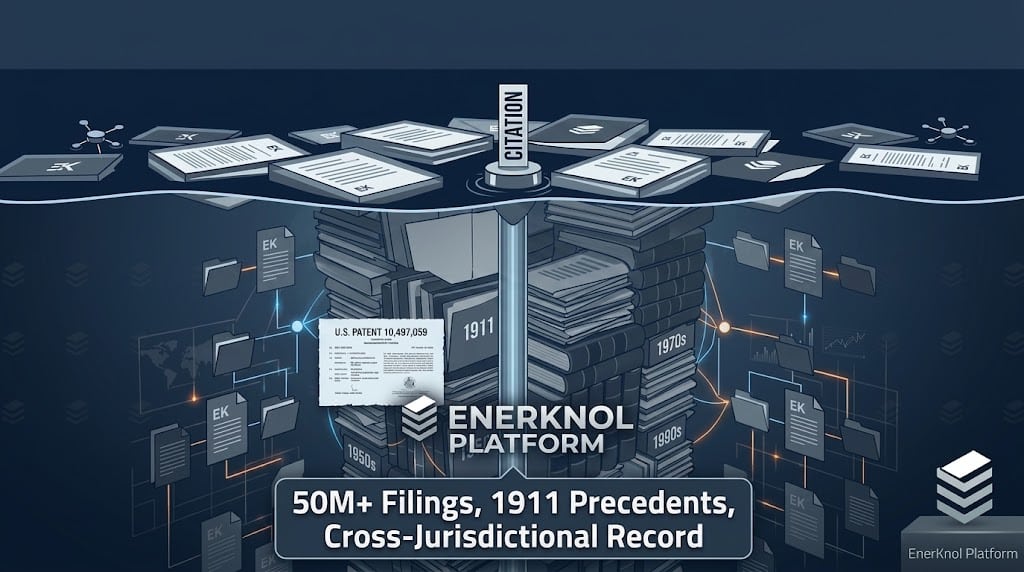
Citations Are Table Stakes. The Record Behind Them Isn’t.
In regulatory technology, citations are now table stakes. AI research tools routinely surface sources—a vital step for a field demanding defensible conclusions. But this progress masks a dangerous assumption: that a citation equals quality. It doesn’t.
A citation is merely a pointer. It identifies where an answer originated, but says nothing about whether that source represents the whole story. A perfectly cited answer drawn from a shallow record is still a shallow answer—it just has a footnote.
A perfectly cited answer drawn from a shallow record is still a shallow answer — now wearing a footnote.
Citations guarantee traceability, not authority. They cannot confirm if a corpus includes the federal actions, state statutes, or decades-old orders that actually govern the issue. The real differentiator isn’t the citation itself, but the record behind it.
Breadth: Cross-Jurisdictional Authority
Energy regulation is not a silo. Policy is shaped by an interconnected web of legislatures, courts, federal agencies, and ISOs/RTOs. A tool indexing only commission dockets will miss the statutory or market origins of the very policy it describes. True breadth requires a citation that reaches across every branch of government, not just one.
Depth: The Long Tail of Precedent
Critical proceedings often hinge on precedents set decades ago. Effective research requires the original orders, tariffs, and testimony from thirty to seventy years back. An archive starting in 2020 might produce a cited answer, but it often produces the wrong one. Depth is the difference between finding the controlling authority and confidently citing obsolete data.
Lifecycle: Distinguishing Proposed from Approved
Citations often fail at the lifecycle level. A utility may request a 10.5% ROE while the commission approves 9.6%. Both are citable; only one governs. A record that treats documents as flat text risks providing the wrong figure. EnerKnol utilizes lifecycle metadata to distinguish motions from judgments and proposals from final decisions, ensuring you cite the number that actually matters.
The defining question for any regulatory tool is no longer “Does it cite?” but “What is it citing?”
EnerKnol was built to provide the definitive answer. By integrating 900+ institutional sources into a single, searchable record of 50M+ filings—with an archive reaching back to 1911—we provide a depth and breadth unmatched in the industry.
Our patented data method (U.S. Patent 10,497,059) normalizes messy government output into a connected, authoritative record. EKAI doesn’t just return text; it returns answers grounded in the primary filing, with the full proceeding lifecycle intact. This ensures that every citation is backed by the comprehensive truth of the record.
This distinction was central to the New Mexico Public Regulation Commission’s recent platform review. Tasked with supporting 124 staff members, the Commission prioritized institutional breadth, historical depth, and cross-jurisdictional research over simple citation capabilities. It concluded that EnerKnol was the only source capable of meeting these comprehensive requirements, noting its integration of sources as “unique among the platforms reviewed.”
Citations got us to the starting line. They made AI answers checkable, and that’s real. But in a field where being confidently wrong is a professional hazard, the finish line is the record itself — how wide, how deep, and how well it understands the proceedings it contains.
Cite everything. Then ask what you’re citing from.
See what the whole record looks like.Request a briefing or sign up for a trial
The EnerKnol Platform – Regulatory intelligence across the full energy record — 900+ sources, 50M+ filings, back to 1911.