

PJM Capacity Auction Again Falls Short of Reliability Target as Power Demand Outpaces Supply
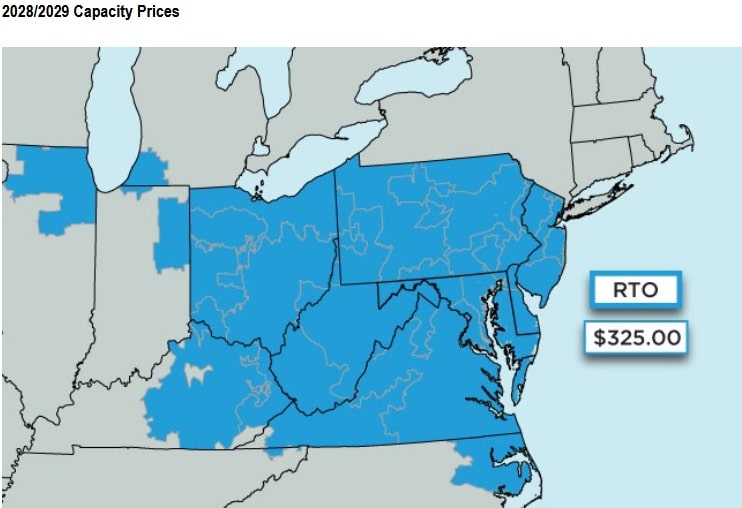
PJM Interconnection on July 14 announced the results of its 2028/2029 capacity auction, marking the second consecutive auction in which committed electricity resources fell short of the grid operator’s reliability requirement. The auction secured about 138,300 megawatts of accredited capacity to serve more than 67 million customers across 13 states and the District of Columbia. Together with 10,864 megawatts procured by utilities using the Fixed Resource Requirement approach, total committed capacity reached about 149,200 megawatts, leaving a roughly 6,800-megawatt shortfall against PJM’s long-term reliability target.
The auction cleared at the Federal Energy Regulatory Commission-approved price cap of $325 per megawatt-day, about 2.5 percent below the previous auction’s capped clearing price of $333.44 per megawatt-day. The auction’s total value reached about $16.4 billion, although PJM noted that many utilities rely on self-supply and bilateral contracts, limiting customers’ exposure to auction clearing prices.
The latest results reflect continued growth in electricity demand, driven in part by expanding data center development, even as new generation continues to enter the system more slowly than needed. Although supply offered into the auction and cleared capacity both increased from the previous auction, PJM maintained a 14.7 percent reserve margin while remaining below its one-event-in-10-year reliability standard. Natural gas remained the largest source of committed capacity at 46 percent, followed by nuclear at 20 percent and coal at 18 percent. Coal capacity continued to decline because of retirements and fuel conversions, while solar capacity expanded with new projects.
To strengthen reliability, the grid operator plans to seek FERC approval to hold a Reliability Backstop Procurement in September. PJM is also advancing reforms to accelerate generator interconnections, including the use of Google’s Tapestry artificial intelligence platform, developing a connect and manage framework for large electricity users such as data centers, establishing a temporary expedited interconnection process for up to 10 state-supported generation projects, and facilitating long-term bilateral agreements between large customers and generation providers.
PJM expects to hold its next capacity auction in December as it works toward restoring its three-year-forward planning cycle. The latest results reinforce concerns that electricity demand is continuing to outpace the pace of new resource additions, leaving reliability pressures unresolved despite incremental growth in available capacity.
EnerKnol Pulses like this one are powered by the EnerKnol Platform—the first comprehensive database for real-time energy policy tracking. Sign up for a free trial below for access to key regulatory data and deep industry insights across the energy spectrum.
ACCESS FREE TRIAL