

U.S. Hydropower Generation Expected to Rise by 7.5 Percent This Year: EIA
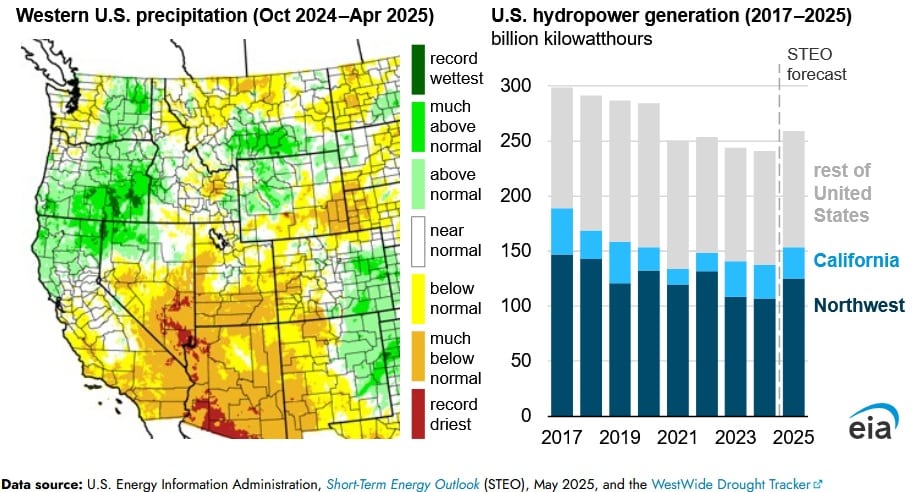
U.S. hydropower generation is expected to increase by 7.5 percent to 259.1 billion kilowatthours (BkWh) during 2025, however will remain 2.4 percent below the previous 10-year average, according to a May 19 report published by the U.S. Energy Information Administration. Hydropower production during 2024 declined to 241 billion BkWh, the lowest level since at least 2010. This decrease is attributed to extreme and exceptional drought conditions affecting various regions of the U.S., particularly in the Pacific Northwest, where the majority of the U.S. hydropower capacity is based.
Several regions have been impacted by drought conditions, with the effects on hydropower production especially pronounced in the Pacific Northwest. The Pacific Northwest’s Columbia River is one of largest rivers in the U.S. by volume. The Columbia River Basin spans significant portions of four states: Idaho, Oregon, Washington, and Montana. A number of large U.S. hydropower dams are located in the basin, such as the Chief Joseph and Grand Coulee.
Hydropower generation in 2023 fell to a 22-year low due to reduced water supply, especially in Washington and Oregon, where a May heatwave rapidly melted the snowpack and limited water availability for the rest of the year.
Around half of the hydropower generating capability in the U.S. is in the western states of Washington, Oregon, and California. The agency projects hydropower generation in the Northwest and Rockies region to be 125.1 BkWh during 2025, up 17 percent compared to last year, however it will remain four percent below the previous 10-year average. Hydropower generation in California is projected to be 28.5 BkWh, up six percent compared to last year and 15 percent more than the previous 10-year average.
EnerKnol Pulses like this one are powered by the EnerKnol Platform—the first comprehensive database for real-time energy policy tracking. Sign up for a free trial below for access to key regulatory data and deep industry insights across the energy spectrum.
ACCESS FREE TRIAL