

U.S. Residential Electricity Bills Expected to Marginally Increase This Summer: EIA
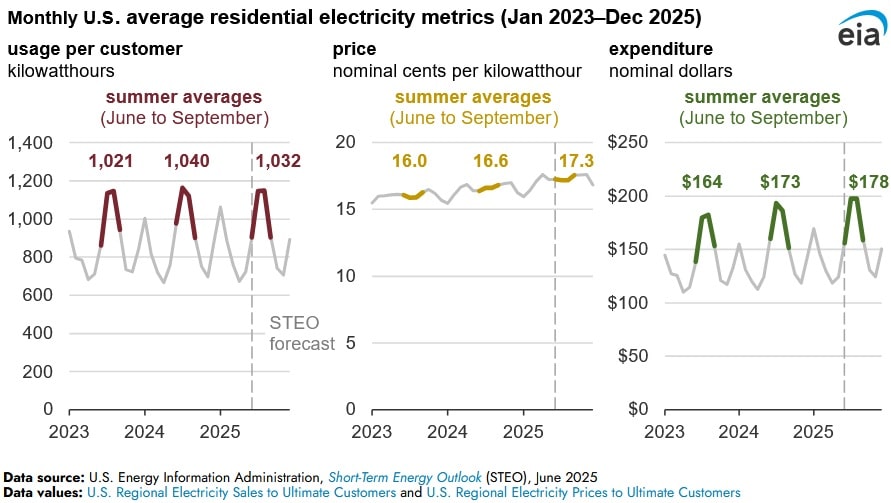
U.S. residential customers are expected to receive an average monthly electricity bill of $178 for the summer 2025 period, up by $5 compared to the same period last year, according to a June 23 report published by the U.S. Energy Information Administration. The agency expects a slight decline in usage due to cooler projected summer temperatures compared to last year, which partially counterbalances the projected rise in residential electricity prices in most regions of the U.S.
The agency projects a one percent reduction in the number of cooling degree days compared to summer 2024. The projected cooler temperatures are expected to lead to lower U.S. residential electricity usage, which is also expected to decline by less than one percent compared to the previous summer.
U.S. household power consumption is usually higher in the summer compared to other periods in the year, due to around 90 percent of U.S. households using air conditioning. Consumers situated in the southern states along the Gulf Coast usually utilize higher amounts of electricity because of hot summer weather. Households in states with milder temperatures along the Pacific Coast and in New England consume lower volumes of power during summer in comparison to other regions.
Electricity bills are impacted by both the volume of grid delivered electricity utilized by customers and retail electricity prices. Moreover, electricity bills can vary significantly between states. During 2024, residential electricity prices in states such as Connecticut and Hawaii were relatively higher, and as a result customers paid over $200/month for their electricity, or more than double as customers in states such as Utah and New Mexico.
This summer, New England residential consumers will most likely see the largest rise in average monthly electricity expenditures, with an expected increase of $13 compared with summer 2024. West South-Central and New England regions are projected to have the highest overall electricity bills during the summer. Residential users in the East South-Central and South Atlantic regions are likely to experience marginal electricity bill increases, similar to the previous summer. In contrast, in the Pacific region and Mountain region, residential bills are projected to be lower because of weaker consumption after near-record temperatures in the West during summer 2024.
Aside from the commodity price impacting the overall bill, non-commodity costs across the U.S. continue to increase. Transmission and distribution costs have been key drivers behind the increase in U.S. retail electricity prices in recent years. The cost of distribution and transmission has increased on the back of companies developing new infrastructure or changing existing assets and pipelines to assist in integrating growing renewable generation sources.
EnerKnol Pulses like this one are powered by the EnerKnol Platform—the first comprehensive database for real-time energy policy tracking. Sign up for a free trial below for access to key regulatory data and deep industry insights across the energy spectrum.
ACCESS FREE TRIAL