carbon capture

Virginia Governor Vetoes Bill Preventing Participation in Regional Carbon-Trading Program

Democratic Governor Ralph Northam vetoed legislation on March 14 that would prohibit the state from joining a regional carbon program to reduce power plant emissions, without a two-thirds majority vote from both the legislative chambers. Northam also vetoed a similar bill related to limiting emissions from vehicles, saying that the measures violate the state constitution…

Kentucky Passes Bill That Could Stall Residential Solar Growth

Kentucky Passes Bill That Could Stall Residential Solar Growth

Kentucky lawmakers passed legislation on March 14 that would redefine net metering by requiring state regulators to set the compensation rate for solar customers through a ratemaking process. Retail electric suppliers would be entitled to implement rates to recover the costs incurred to serve customer-generators, including fixed and demand-based charges. (SB 100) The bill would…...

Illinois Lawmakers Float Bill Boosting Renewable Target to 40 Percent by 2030

Illinois Lawmakers Float Bill Boosting Renewable Target to 40 Percent by 2030

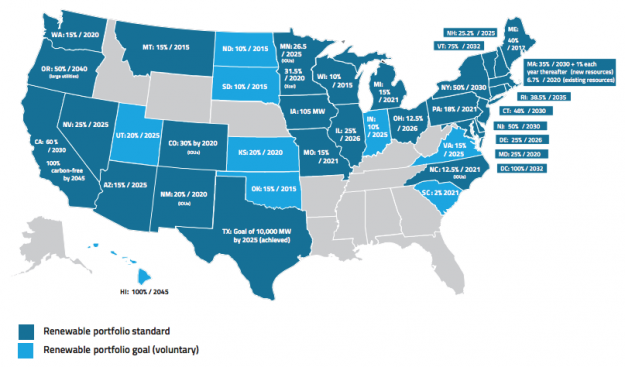
Illinois lawmakers are considering a bill known as the Path to 100, which would boost the state’s renewable portfolio standard to 40 percent by 2030, up from the current 25 percent by 2025, as well as improve opportunities for utility-scale renewable projects to get approval and begin construction, putting the state on a path to 100 percent clean…

Kansas Regulator Declines to Mandate Smart Meter Opt-Out Program, Citing Difficulty in Implementation

Kansas Regulator Declines to Mandate Smart Meter Opt-Out Program, Citing Difficulty in Implementation

The Kansas Corporation Commission decided that there is no need for utilities to offer an alternative metering solution for customers who wish to opt out of advanced meters, according to a March 14 order. The agency said that implementing an opt-out program would be difficult, given the high costs and administrative burden. Such a program…...

U.S. Energy Department

Nevada State Lawmaker Proposes Bill to Double Renewable Standard, Set Goal for 100 Percent Carbon-Free Electricity

Democratic Senator Chris Brooks introduced legislation on March 18 that would raise Nevada’s renewable portfolio standard to 50 percent by 2030 from the current level of 25 percent by 2025. The bill would also set a goal of achieving all of the state’s electricity from carbon-free resources by 2050. The legislation adds to the number…...

States Make Strides in Setting Pay Outs for Battery Storage, Opening Door to Growth

EnerKnol’s Visual Primer – States Make Strides in Setting Pay Outs for Battery Storage, Opening Door to Growth

U.S. states are plowing ahead in setting market compensation rules for battery technology, laying the foundation for future growth of the fast-maturing technology in retail and wholesale markets. While progressive states California, New York and Massachusetts are charging ahead in how to value the resource, others are still grappling with how to regulate a system that fails to fit squarely in any one box and that raises a range of jurisdictional and ownership questions.

Puerto Rico Electric Power Authority Asked to Redo Long-Term Resource Plan

Puerto Rico Electric Power Authority Asked to Redo Long-Term Resource Plan

The Puerto Rico Energy Commission on March 14 found that the Puerto Rico Electric Power Authority’s proposed integrated resource plan did not comply with the agency’s regulation and prior orders. The agency said that the plan includes a scenario titled “Energy System Modernization Plan,” which does not meet the regulatory requirement to use a capacity…

Maine Brings Back Net-Metering, Sets the Stage for Renewable Portfolio Standard Boost

Maine Brings Back Net-Metering, Sets the Stage for Renewable Portfolio Standard Boost

The Maine legislature passed a bill on March 15 that would reestablish net metering for consumers with solar installations, doing away with the previous administration’s gross metering policy. The legislation, introduced by State Representative Seth Berry, a Democrat, will likely be signed by fellow Democratic governor Janet Mills. Gross metering was developed by the Maine Public Utility Commission with…

Court Rules Against FERC in $42 Billion Jurisdictional Dispute Over PG&E Bankruptcy

Court Rules Against FERC in $42 Billion Jurisdictional Dispute Over PG&E Bankruptcy

The U.S. District Court for the Northern District of California on March 11 ruled that the bankruptcy code is adequate to decide the future of Pacific Gas & Electric Company’s wholesale power purchase contracts. The Federal Energy Regulatory Commission claimed that the agency has concurrent jurisdiction with bankruptcy courts over wholesale contracts that the utility…

New Mexico Commits to 100 Percent Clean Electricity, Joining California, Hawaii and D.C.

New Mexico Commits to 100 Percent Clean Electricity, Joining California, Hawaii and D.C.

The New Mexico House of Representatives passed the Energy Transition Act on Tuesday afternoon, which orders the state to source all of its power from carbon-free supplies by 2045. The bill passed the Democratic-controlled state legislature with 32-9 votes in the Senate and 43-22 in the House. Democratic governor Michelle Lujan-Grisham is expected to sign it into…

U.S. Added Over 31 Gigawatts of Electric Generating Capacity in 2018, Largest in 15 Years

U.S. Added Over 31 Gigawatts of Electric Generating Capacity in 2018, Largest in 15 Years: EIA

The U.S. added 31.3 gigawatts of generating capacity in 2018, the largest since the 2003 capacity addition of 48.8 gigawatts, according to a March 11 report from the Energy Information Administration. Natural gas accounted for 62 percent of utility-scale additions, while wind and solar photovoltaic represented 21 percent and 16 percent, respectively. Coal accounted for…...

U.S. States Intensify Scrutiny of Advanced Meter Program Costs, Putting Deployments at Risk

EnerKnol’s Visual Primer – U.S. States Intensify Scrutiny of Advanced Meter Program Costs, Putting Deployments at Risk

The spread of advanced meters across the U.S. has come a long way, with over half of the nation's 152 million electricity consumers now hooked up to the devices. But further deployment of the technology, seen critical for a more responsive and reliable grid, is at risk amid heightened scrutiny from regulators, who are increasingly bowing to concerns over the costs to consumers.