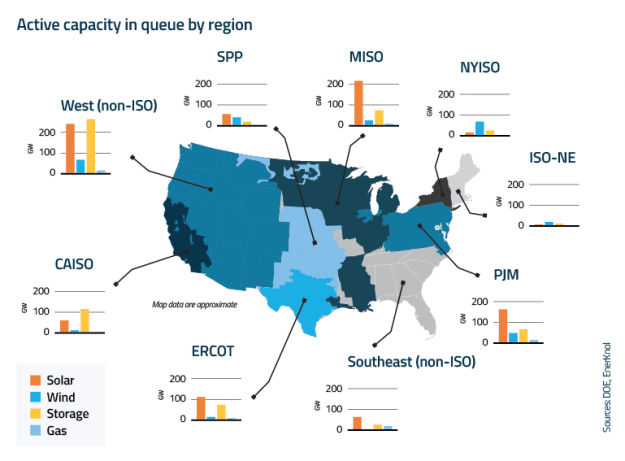
Federal actions are paving the way to build out new transmission capacity at the pace required to accommodate shifts in power generation and achieve decarbonization goals while enhancing grid reliability.
As renewables continue to grow in the move towards a low-carbon future, energy storage is critical to mitigate the variability of wind and solar resources and enhance reliability and resiliency of the electric grid. Federal and state actions continue to facilitate the adoption of storage as a key solution…Read the full report …...
As renewables continue to grow in the move towards a low-carbon future, energy storage is critical to mitigate the variability of wind and solar resources and enhance reliability and resiliency of the electric grid. Federal and state actions continue to facilitate the adoption of storage as a key solution in this transition. U.S. utility-scale battery storage capacity is expected to increase from 1.5 gigawatts (GW) in 2020 to 30 GW in 2025, according to the U.S. Energy Information Administration.
The commitment to a low-carbon future is growing stronger, with states and utilities diversifying their energy transition strategies. There is a growing awareness of the magnitude of the transition including the scale of grid modernization, supply chain challenges, and economic realities as renewable resources and decarbonization technologies expand. Supportive policies and technological advancements are key…...