New York Governor Kathy Hochul on Dec. 28 announced an increase in emergency aid for low-and middle-income families to keep their homes heated during the winter. The move aims to prevent disconnecting or exhausting sources amid expected increases in fuel prices. Compared to last year, the emergency benefit planned for this winter ranges from 32…...
The Electricity Reliability Council of Texas (ERCOT) announced on Dec.30 it has completed on-site inspections of mandatory winterization efforts and concluded that the independently owned power generation fleet and transmission companies serving the region are prepared for winter weather. The grid operator conducted inspections at facilities, which represent 85 percent of the megawatt hours lost…...
The U.S. Energy Department on Dec. 16 announced a $100 million funding opportunity to support innovative technologies that can contribute to emissions reductions, increase energy efficiency, and support grid modernization. The agency’s Advanced Research Projects Agency-Energy (ARPA-E) will run the funding program, which is expected to support President Biden’s Building a Better America initiative by…...
The U.S. President Joe Biden issued an executive order on Dec. 8 directing the federal government to use its procurement power to achieve ambitious emissions reduction and clean energy goals. This action is expected to facilitate the development of at least 10 gigawatts of carbon-free electricity by 2030 and fast-track the nation’s capacity to supply…...
The California Public Utilities Commission on Dec. 2 introduced new programs and modifications to existing programs to lower energy demand and increase supply during critical hours to prevent electricity breakdowns during extreme heat events such as the west-wide heat waves of 2020 and 2021. To protect the grid during extreme weather seasons, the regulator approved…...
The Michigan Public Service Commission on Dec. 9 initiated a study to examine the potential of renewable natural gas (RNG) development. The study aims to identify existing and potential sources of RNG in Michigan and any barriers to development, in order for the state to provide a carbon neutral energy solution, using the existing natural…...
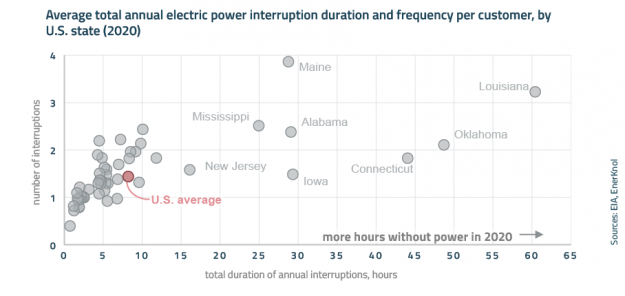
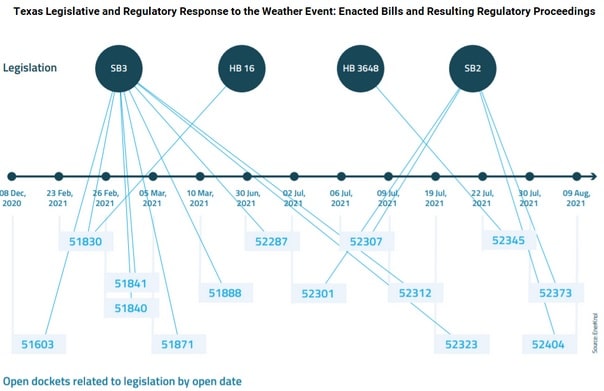
The growing incidence of extreme weather events has triggered regulatory and legislative efforts across the U.S. to improve the reliability and resilience of the energy system. Winter Storm Uri, which caused widespread outages in the South Central U.S. in February, prompted a regulatory upheaval in Texas, which suffered the brunt of the storm, leaving more than 4.5 million people without power. California has adopted measures to ensure reliability in the event of extreme weather in the summers of 2022 and 2023. Federal regulators have approved new cold weather electric reliability standards.
The Texas Public Utility Commission staff on Dec. 8 filed reports of violation against eight generation companies for failing to timely submit winter weather readiness plans. Thirteen of the state’s 850 generation resources owned by these companies missed the Dec. 1, 2021 deadline. In October, the commission adopted a rule addressing weather emergency preparedness of…...
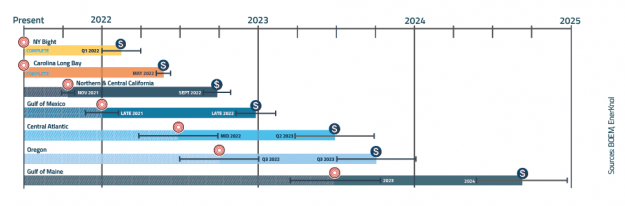
Interest in offshore wind energy has reached new levels driven by supportive federal action, ambitious state procurement targets, and evolving technology. Recent developments include federal approval of the second commercial-scale project, and plans to hold up to seven new lease sales by 2025 in the East Coast, as well as the West and Gulf Coasts. Despite the progress, the industry faces opposition with recent lawsuits challenging the approval of the nation’s first major offshore project, the 800-megawatt (MW) Vineyard Wind I venture, over its potential impact to the fishing industry and endangered species.
The Biden administration is walking a tightrope on climate action as recent moves in the oil and gas industry challenge its aggressive climate agenda, which calls for net-zero emissions by 2050.