U.S. EPA Finalizes Repeal of 1995

U.S. EPA Finalizes Repeal of 1995 ‘Once In, Always In’ Policy for Major Air Pollution Sources

The U.S. Environmental Protection Agency on Oct. 1 finalized a rule allowing a major source of hazardous air pollutants to reclassify as an “area source,” a less stringent category under the Clean Air Act, any time it implements measures to limit emissions. The action implements the agency’s 2018 guidance that withdrew the 1995 “Once In,…...

California’s Efforts to Cut Transportation Emissions Are Inadequate

U.S. EPA Announces $73 Million in Funding for Clean Diesel Initiatives

The U.S. Environmental Protection Agency on Sept. 29 announced $73 million in funding and grants to support initiatives aimed to reduce diesel emissions from existing engines. About $50 million in Diesel Emissions Reduction Act funding is expected to be allotted for projects intended to address diesel emissions from the nation’s existing fleet. The 2020 grants…...

U.S. EPA Reverses Finding That Formed Basis for Obama-Era Power Plant Mercury Rules

Pennsylvania Governor Vetoes Bill That Would Have Stalled Efforts to Join RGGI

Pennsylvania Governor Tom Wolf, a Democrat, vetoed legislation, which would have prevented the state from implementing measures to limit carbon emissions without legislative approval. The state’s Environmental Quality Board recently voted in favor of a proposed regulation that would allow the state to participate in the Regional Greenhouse Gas Initiative, or RGGI, a cooperative effort…...

Vermont Legislation Creates Initiatives to Cut emissions From Thermal Energy, Transportation Sectors

Vermont Legislation Creates Initiatives to Cut emissions From Thermal Energy, Transportation Sectors

Vermont Governor Phil Scott, a Republican, signed legislation on Sept. 23, which directs energy efficiency funds to support emissions reduction measures in the thermal energy and transportation sectors for a period of three years. The new law requires the Public Utility Commission to authorize an entity appointed to provide energy efficiency and conservation programs to…...

Grid Modernization Strategies

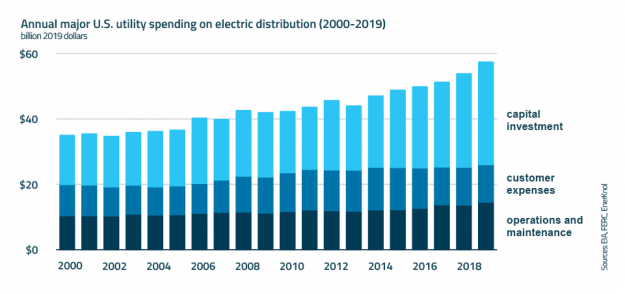
Visual Primer: Grid Modernization Strategies Increasingly Center on Innovation and Customer Engagement

State policy goals are driving comprehensive grid modernization endeavors aimed at transitioning to a flexible and efficient grid that caters to the needs of the evolving electric sector and diverse customer interests. A growing number of state regulators and utilities alike are embarking on innovative ventures, striving towards necessary enhancements to accomplish energy and environmental goals.

renewables

Maine Selects 546 Megawatts of Projects for Long-Term Renewable Energy Contracts

The Maine Public Utilities Commission on Sept. 23 approved 17 renewable energy projects totaling 546 megawatts to enter into long-term contracts with the state’s investor-owned utilities. The projects represent solar, wind, hydro-electric, and biomass resources, with solar accounting for 482.5 megawatts of the capacity. The selection, which marks the largest renewable energy procurement in Maine,…...

President Biden Commits U.S. to Achieve 50 Percent Emissions Reductions in 2030

Michigan Regulator Seeks to Update Utility Resource Planning to Reflect New Carbon-Neutrality Goal

The Michigan Public Service Commission on Sept. 24 requested staff and stakeholders in its MI Power Grid initiative to recommend how utility resource planning requirements should be revised to reflect the new emissions reductions goals set by an executive order from Governor Gretchen Whitmer.  The order, issued on Sept. 23, creates the MI Healthy Climate…...

U.S. Energy Department Picks Kentucky University for $120 Million Battery Science Program

U.S. Energy Department Invests $24 Million to Advance Battery, Methane Detection Technologies

The U.S. Energy Department on Sept. 16 announced $24 million in funding for projects designed to commercialize efforts in sodium-ion battery development and methane detection technologies. The initiative, titled Seeding Critical Advances for Leading Energy technologies with Untapped Potential, is the first-of-its kind to build on the research and development efforts of the agency’s Advanced…...

Fossil Fuels Account for 80 Percent of U.S. Energy Production, Consumption: EIA

Fossil Fuels Account for 80 Percent of U.S. Energy Production, Consumption: EIA

The share of U.S. energy production from fossil fuels peaked in 1966 at 93 percent, but production from nuclear power and renewables have also risen. Fossil fuels have accounted for about 80 percent of U.S. energy production in the past decade, according to a Sept. 14 report from the U.S. Energy Information Administration. In 2019,…...

U.S. Natural Gas Exports Decline Amid Economic Slowdown Caused by COVID-19: EIA

U.S. Natural Gas Exports Decline Amid Economic Slowdown Caused by COVID-19: EIA

U.S. net natural gas exports continued to grow in the first six months of 2020 compared to the same period last year, but began to decline in spring 2020 due to the global economic slowdown resulting from the COVID-19 pandemic and related containment measures, according to a Sept. 15 report from the U.S. Energy Information…...

U.S. Energy Department Announces $420 million to Accelerate Clean Energy Initiatives

New Jersey Enacts Landmark Environmental Justice Law

Democratic Governor Phil Murphy signed legislation on Sept. 18, which directs the state to deny permits if an environmental justice analysis finds that a new facility will have a disproportionate impact on overburdened communities. The law marks the toughest measure in the nation to safeguard overburdened communities from pollution. Under the bill, “overburdened” applies to…...

Washington Enacts Law Requiring Electric Utilities to Plan for Distributed Energy Future

FERC Opens Wholesale Electricity Markets to Distributed Energy Resources

The Federal Energy Regulatory Commission on Sept. 17 approved a long-awaited rule, directing regional grid operators to open their markets to distributed energy resource aggregations. The order removes barriers preventing these resources from competing on a level playing field in the wholesale capacity, energy, and ancillary services markets. The rule requires regional grid operators to…...