

Strait of Hormuz a Critical Supply Route for Qatari LNG: EIA
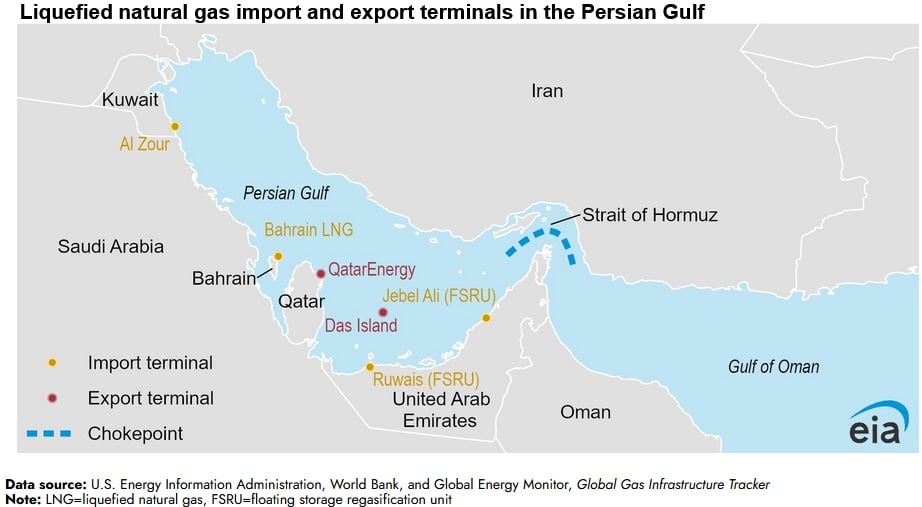
Qatar exported around 9.3 billion cubic feet per day (Bcf/d) of liquefied natural gas (LNG) through the Strait of Hormuz during 2024, according to a June 24 report published by the U.S. Energy Information Administration. The strait remains a key supply route for global LNG, as well as oil and petroleum products. During 2024, around 20 percent of global LNG trade transited through the strait, highlighting the straits’ importance to the dynamics of the global gas market.
The strait connects the Persian Gulf with the Gulf of Oman and the Arabian Sea. The strait is one of the world’s most significant chokepoints, with a large amount of LNG and oil flow. If the strait is closed, there are only a small number of alternative possibilities to move product out of the strait. A disruption in LNG supply via the strait could have significant impacts on global gas trading dynamics, since Qatar is a major exporter to the Asian market. In the absence of Qatari gas, the Asian markets would import LNG from the U.S., which would tighten gas supply in the European gas markets.
The agency estimates that 83 percent of the LNG that transited via the strait during 2024 went from Persian Gulf countries to Asian markets. South Korea, India and China were the key markets for LNG moving via the strait, accounting for 52 percent of all Hormuz LNG supply during 2024. The United Arab Emirates (UAE) exported around 0.7 Bcf/d of LNG via the strait during 2024, combined with the volumes exported by Qatar, this accounts for almost all LNG supply from Persian Gulf via Hormuz.
The strait is also a vital LNG import route. The UAE and Kuwait imported LNG from West Africa and the U.S. Bahrain began operating an LNG import terminal during April 2025 and also received cargoes that passed through the Hormuz from outside of the Persian Gulf, including cargoes from the U.S. during April and June.
EnerKnol Pulses like this one are powered by the EnerKnol Platform—the first comprehensive database for real-time energy policy tracking. Sign up for a free trial below for access to key regulatory data and deep industry insights across the energy spectrum.
ACCESS FREE TRIAL