

Share of Imports in U.S. Energy Supply Hits 40-Year Low: EIA
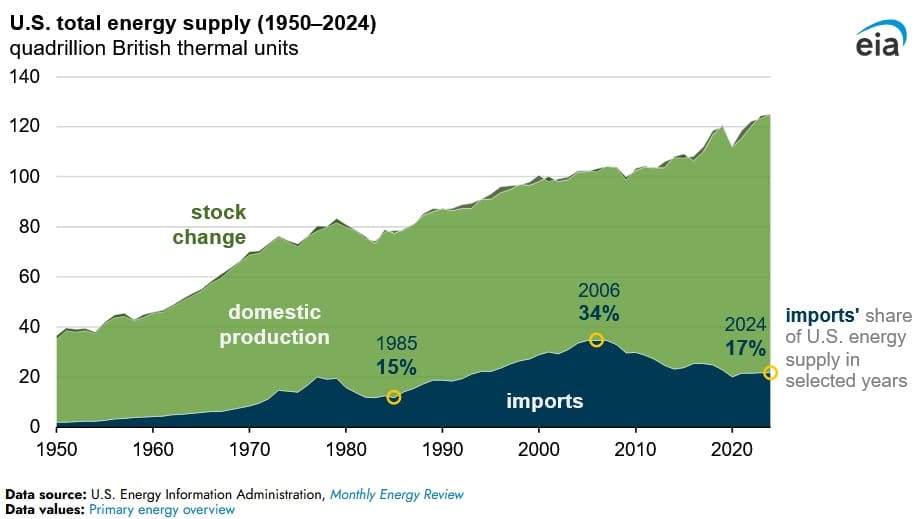
The U.S. imported around 17 percent of its domestic energy supply during 2024, according to a July 7 report published by the U.S. Energy Information Administration. This marks the lowest share since 1985 and half the record share set during 2006. The reduction in the share of imports over the past two decades is due to a combination of rising domestic energy production and a decline in energy imports since 2006.
The U.S. energy supply is derived from three main sources: domestic energy production, imports from other countries, and energy withdrawn from storage. In 2024, the U.S. remained a net energy exporter for the third year in a row, producing a record-high amount of energy that continued to surpass domestic consumption. That year, U.S. production reached all-time highs in crude oil, natural gas, natural gas plant liquids, solar, wind and biofuels energy. U.S. total energy production surpassed 103 quadrillion British thermal units in 2024, up one percent from the previous record set in 2023. The largest source of U.S. domestic energy production during 2024 was natural gas, which accounted for around 38 percent of total energy production.
In 2024, total U.S. energy imports were approximately 22 quadrillion British thermal units and have remained relatively stable since 2021. Crude oil and refined petroleum products made up 84 percent of those imports, while natural gas accounted for the majority of the remaining 15 percent.
From 2006 to 2024, U.S. imports of petroleum products and crude oil declined by 39 percent, dropping from around 14 million barrels per day (b/d) to 8 million b/d. This decrease occurred entirely in the Gulf Coast—where a significant portion of domestic consumption and production is concentrated—and the East Coast, which accounts for a large share of domestic consumption. The increase in energy production, most notably crude oil production, can be attributed to enhancements in drilling techniques such as horizontal drilling and hydraulic fracturing.
In 2006, OPEC nations collectively supplied the largest portion of U.S. petroleum and crude oil imports. Since that time, imports from OPEC countries have dropped by 77 percent, while imports from Canada have nearly doubled.
EnerKnol Pulses like this one are powered by the EnerKnol Platform—the first comprehensive database for real-time energy policy tracking. Sign up for a free trial below for access to key regulatory data and deep industry insights across the energy spectrum.
ACCESS FREE TRIAL