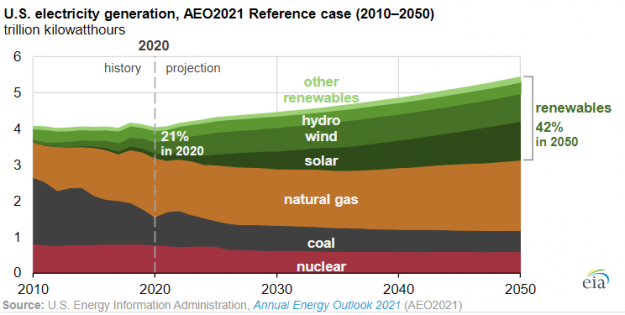
Renewables to Outpace Natural Gas to Become Predominant Electricity Source in 2030: EIA

Renewables to Outpace Natural Gas to Become Predominant Electricity Source in 2030: EIA

The share of renewables in the U.S. power generation mix is expected to rise from 21 percent in 2020 to 42 percent in 2050, according to the U.S. Energy Information Administration’s 2021 annual outlook. The agency projects that renewable energy, driven by wind and solar power, will surpass natural gas to become the predominant source…...
renewables

Delaware Law Raises Renewable Portfolio Standard to 40 Percent by 2035

Delaware Governor John Carney, a Democrat, signed legislation on Feb. 10 which increases the state’s renewable portfolio standard for regulated utilities to 40 percent by 2035, up from the prior target of 25 percent by 2025. The bill also raises the solar carve-out to 10 percent by 2035, nearly tripling the previous level of 3.5…...

Policy Primer: Competitive Retail Electricity Markets

Policy Primer: Competitive Retail Electricity Markets

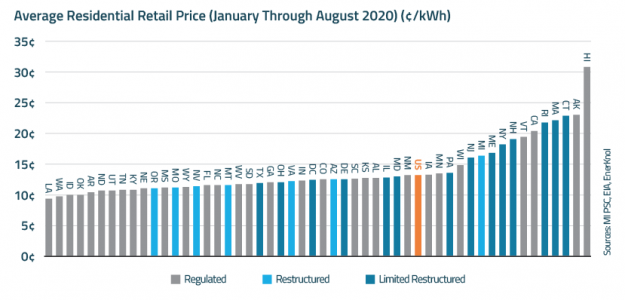
Interest in retail electric competition has been growing as innovative sources of energy production emerge, giving consumers an active role in managing their power supply. This has led to increased oversight as policymakers and regulators explore reforms to enhance customer protections while encouraging the development of a competitive market.

California Adopts New Standard Contracts for Small Generators Under Federal Power Purchase Law

Michigan Regulator Explores Rate Design for Distributed Energy Resources

The Michigan Public Service Commission on Feb. 4 established a workgroup to analyze rate design options for distributed energy resources. The commission also adopted a definition for utility pilot projects and criteria for pilot program reviews under the MI Power Grid initiative, the state’s grid modernization effort intended to maximize the benefits of the shift…...

EnerKnol Research PU Visual Primer Renewable Natural Gas 2021 02 02 Blog preview

Visual Primer: Renewable Natural Gas Emerging as Utility Decarbonization Strategy

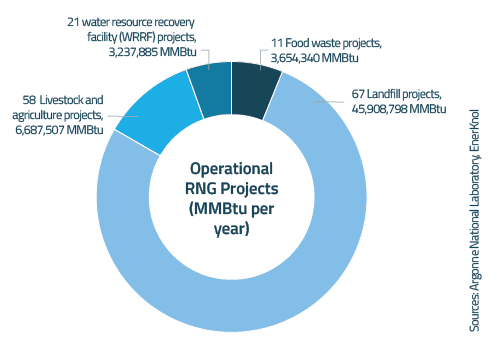
U.S. state regulators and utilities alike are exploring the use of renewable natural gas (RNG) due to its environmental benefits to displace fossil fuels and to support the transition to a low-carbon energy economy. RNG is pipeline-quality methane produced from biomass that is sourced from livestock operations, landfills, and other organic waste.

Policy Primer: Energy Storage Gains Prominence to Foster Grid Reliability

Policy Primer: Energy Storage Gains Prominence to Foster Grid Reliability

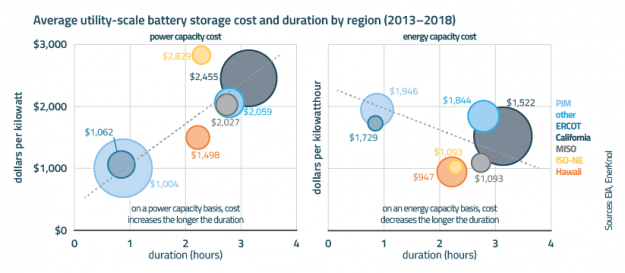
Energy storage initiatives are moving forward at a swift pace to complement clean energy policies as batteries can facilitate the integration of diverse generation technologies and address grid stability. With improving economics, there is a growing discussion on the role of energy storage as a grid asset to foster reliability and optimize renewables to meet ambitious clean energy goals.

New York Advances $485 Million Transmission Project to Enhance Grid Reliability, Support Renewables

New York Regulator Approves $850 Million Power Line to Support Clean Energy

The New York Public Service Commission approved the Marcy to New Scotland Upgrade Project, an $854 million power line starting in Oneida County and extending to Albany County to facilitate greater flow of clean energy to high-demand markets downstate, according to a Jan. 21 press release. The project would replace existing lines with new lines…

U.S. Wind, Solar Developers Brace for Project Delays as COVID-19 Crisis Disrupts Supply Chain

President Biden Takes Action to Rejoin Paris Climate Accord, Review Environmental Rollbacks

U.S. President Joe Biden issued a series of executive actions on Jan. 20 reflecting his energy agenda that prioritizes clean energy and climate action. Biden took action to recommit the U.S. to the Paris Climate Agreement and issued an executive order revoking a key permit for the Keystone XL oil pipeline and temporarily halting oil…...

States Rethink Resource Adequacy Constructs

Policy Primer: States Rethink Resource Adequacy Constructs

Several states are rethinking the resource adequacy paradigm as the electric resource mix changes through the addition of more intermittent resources to replace retiring coal-fired capacity and meet state decarbonization goals. Resource adequacy initiatives are intended to ensure that the planned resource mix is sufficient to meet the future system capacity needs and maintain grid reliability.

Washington Governor Unveils Plan for 100 Percent Clean Energy Following Defeat of Carbon Tax Ballot Initiative

Washington Regulators Adopt Rules to Implement 100 Percent Clean Energy Law

The Washington State Department of Commerce and the Utilities and Transportation Commission on Jan 5 adopted rules for the implementation of the 2019 Clean Energy Transformation Act. The law requires the state’s electricity supply to be carbon-neutral by 2030 and carbon-free by 2045, and directs electric utilities to phase out coal from their generation portfolio…...

Illinois Commission Launches Investigation into Value of Distributed Generation

Florida Approves Duke’s 750-Megawatt Clean Energy Program

The Florida Public Service Commission on Jan 5 approved an agreement on Duke Energy Florida ’s Clean Energy Connection Program. The initiative allows the company to provide its customers with about 750 megawatts of new solar power and offer more options for residents, businesses, and local governments for voluntary participation. The program allows customers to…...

Policy Primer: Distribution System Planning Evolves With Growing DER Deployment

Policy Primer: Distribution System Planning Evolves With Growing DER Deployment

Distribution system planning is occurring across various states as utilities and regulators assess the growing need for grid integration of distributed energy resources (DER) and investments that have long-term implications for the power system.