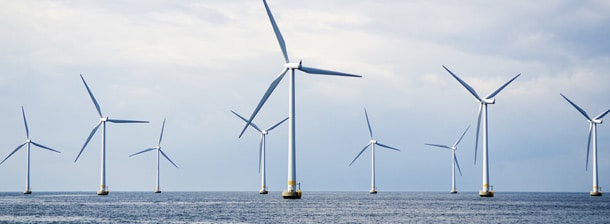
The Biden administration has announced a series of initiatives to advance the U.S. offshore wind industry, including committing to a goal of deploying 30 gigawatts of capacity by 2030. Achieving the 2030 target is expected to lead up to the installation of 110 gigawatts of capacity by 2050. The 2030 goal, a shared commitment by…...
The Ohio legislature on March 25 passed a bill to repeal the provisions of a 2019 law that provided FirstEnergy Solutions Corp., which is now known as Energy Harbor Corp., with annual subsidies of nearly $150 million over seven years to keep its ailing nuclear plants operating. Ohio Governor Mike DeWine, a Republican, is expected…...
Massachusetts Governor Charlie Baker signed legislation on March 26, which commits the state to achieve net-zero emissions in 2050. The law allows Massachusetts to procure an additional 2.4 gigawatts of offshore wind energy, bringing the state’s total authorization to 4 gigawatts by 2027. The law – An Act Creating a Next-Generation Roadmap for Massachusetts Climate…...
Recent progress towards commercializing small modular reactors (SMRs) has sparked interest in the role of advanced nuclear technologies to accomplish decarbonization goals. Twenty states and jurisdictions across the U.S. now have 100 percent clean energy mandates or goals, implying the need for a portfolio of every available carbon-free technology that can be deployed on a timeline compatible with their targets.
As the Biden administration takes action to address climate change through federal policies including rejoining the Paris Agreement and increasing the social cost of carbon, states continue to strengthen existing carbon pricing programs and advance new initiatives. State-level activity on emission-trading programs and carbon pricing is expected to remain on the rise as more jurisdictions embrace policy goals to transition to a lower-carbon power system and economy.
Democratic Governor Tom Wolf on March 22 announced a clean energy initiative that aims to source nearly 50 percent of state government’s electricity from solar installations totaling 191 megawatts to be built across the state. The initiative, called Pennsylvania Project to Utilize Light and Solar Energy, or PULSE, represents the largest government commitment to solar…...
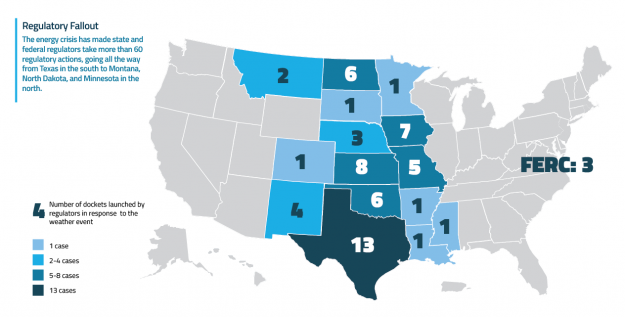
The fallout from severe arctic weather during February has prompted regulators from Texas to Montana to examine utility infrastructure, preparedness and response, and impacts to customers. Texas, which experienced the worst power outages resulting from Winter Storm Uri, has issued multiple orders and initiated investigations to address the impacts of the grid event. Following announcements of an inquiry into the grid event and the possibility of market violations, the Federal Energy Regulatory Commission (FERC) is now set to examine the impacts of climate change and extreme weather events on electric system reliability. Regulators across several U.S. states are investigating the after-effects of the storm to mitigate bill impacts to customers while exploring cost-recovery for utilities which faced extraordinary expenses as natural gas prices soared to unprecedented levels.
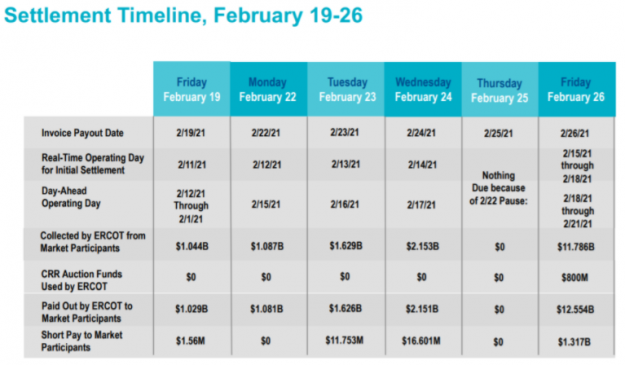
The Electric Reliability Council of Texas Inc. on March 12 held an urgent Board of Directors meeting in which invoice payouts for market participants and settlements across Feb. 19 – March 8 were divulged. From Feb. 13 – 19, the state of Texas was plagued with near-unprecedented grid infrastructure failures due to extreme winter weather…....
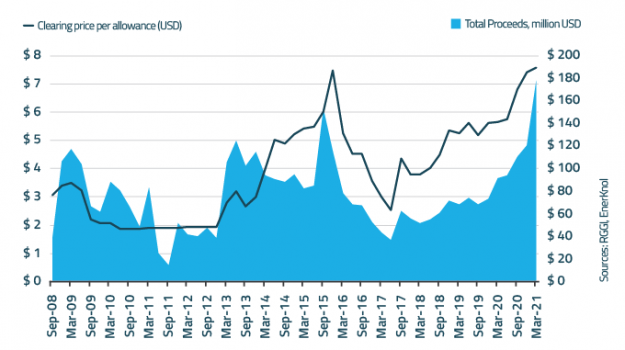
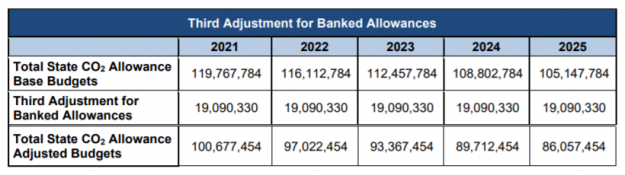
The member states of the Regional Greenhouse Gas Initiative, or RGGI, on March 15 announced the third adjustment for banked allowances held by market participants for the five-year period from 2021-2025. The adjustment is a reduction in the number of carbon allowances that is being sold over the period. The amount of the reduction is…...