Dominion Strikes Deal With Connecticut Utilities to Keep Millstone Nuclear Plant Open

Dominion Strikes Deal With Connecticut Utilities to Keep Millstone Nuclear Plant Open

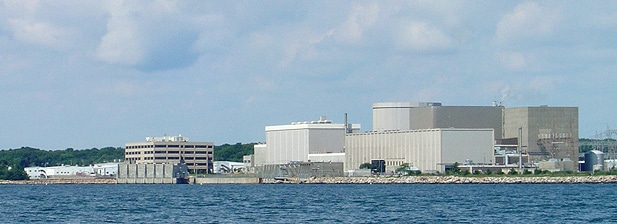
Democratic Governor Ned Lamont announced that Dominion Energy Inc. reached a deal with Connecticut’s two electric utility companies, units of Eversource Energy and Avangrid Inc., to retain the 2,100-megawatt Millstone nuclear facility. The 10-year agreement lowers the incremental ratepayer cost by nearly half compared to the original bid that was accepted last year as part…...

Virginia Enacts Law Establishing Solar Rebates for Low Income Households

Virginia Enacts Law Establishing Solar Rebates for Low Income Households

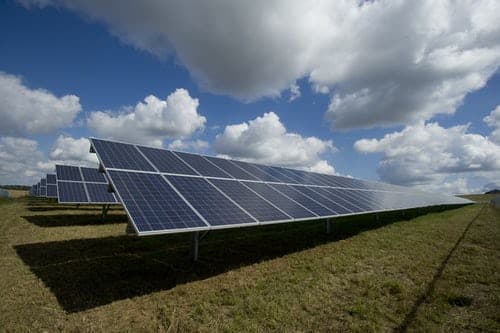
Democratic Governor Ralph Northam signed legislation on March 18 creating a pilot program to disburse loans or rebates for solar installations in households whose income is at or below 80 percent of the state or regional median income. (HB 2741) Residents applying for the program are required to document the installation of energy efficiency services…...

carbon capture

Virginia Governor Vetoes Bill Preventing Participation in Regional Carbon-Trading Program

Democratic Governor Ralph Northam vetoed legislation on March 14 that would prohibit the state from joining a regional carbon program to reduce power plant emissions, without a two-thirds majority vote from both the legislative chambers. Northam also vetoed a similar bill related to limiting emissions from vehicles, saying that the measures violate the state constitution…

U.S. Renewable Generation Doubles in 10 Years Driven by Wind and Solar Additions

U.S. Renewable Generation Doubles in 10 Years Driven by Wind and Solar Additions: EIA

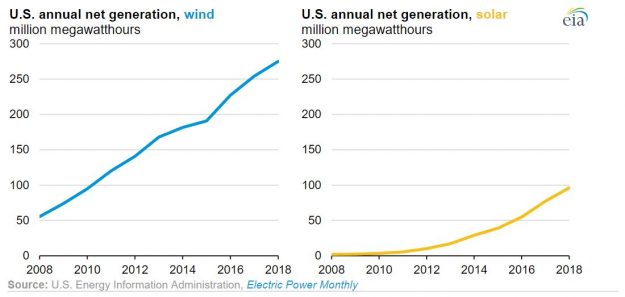
Renewables generated a record 742 million megawatt-hours (MWh) of electricity in 2018, almost double the 382 million MWh produced in 2008, accounting for 17.6% of electricity generation in the United States last year, according to the Energy Information Administration’s Electric Power Monthly. About 90 percent of renewable capacity additions were wind and solar, largely driven by federal and state policies in…

Kentucky Passes Bill That Could Stall Residential Solar Growth

Kentucky Passes Bill That Could Stall Residential Solar Growth

Kentucky lawmakers passed legislation on March 14 that would redefine net metering by requiring state regulators to set the compensation rate for solar customers through a ratemaking process. Retail electric suppliers would be entitled to implement rates to recover the costs incurred to serve customer-generators, including fixed and demand-based charges. (SB 100) The bill would…...

Illinois Lawmakers Float Bill Boosting Renewable Target to 40 Percent by 2030

Illinois Lawmakers Float Bill Boosting Renewable Target to 40 Percent by 2030

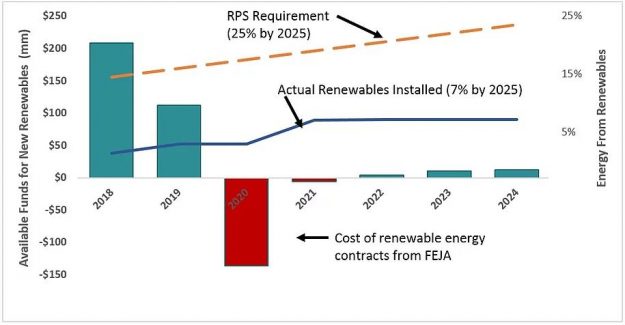
Illinois lawmakers are considering a bill known as the Path to 100, which would boost the state’s renewable portfolio standard to 40 percent by 2030, up from the current 25 percent by 2025, as well as improve opportunities for utility-scale renewable projects to get approval and begin construction, putting the state on a path to 100 percent clean…

Kansas Regulator Declines to Mandate Smart Meter Opt-Out Program, Citing Difficulty in Implementation

Kansas Regulator Declines to Mandate Smart Meter Opt-Out Program, Citing Difficulty in Implementation

The Kansas Corporation Commission decided that there is no need for utilities to offer an alternative metering solution for customers who wish to opt out of advanced meters, according to a March 14 order. The agency said that implementing an opt-out program would be difficult, given the high costs and administrative burden. Such a program…...

U.S. Energy-Related Emissions to Remain Flat Through 2050

U.S. Energy-Related Emissions to Remain Flat Through 2050: EIA

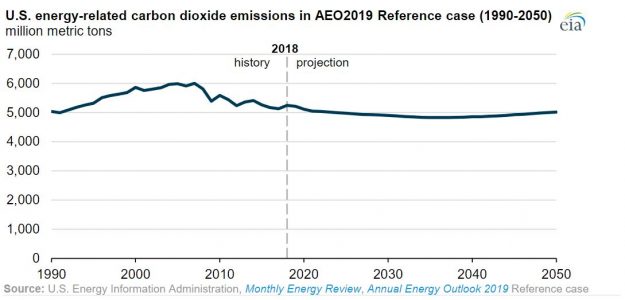
U.S. energy-related emissions of carbon dioxide (CO2) will remain largely unchanged through mid-century, according to projections in the Energy Information Administration’s Annual Energy Outlook 2019. Assuming no changes to current laws and regulations, the agency projects that carbon dioxide emissions will be 5,019 million metric tons in 2050, or 4% below their 2018 value, as emissions associated with coal…

U.S. Energy Department

Nevada State Lawmaker Proposes Bill to Double Renewable Standard, Set Goal for 100 Percent Carbon-Free Electricity

Democratic Senator Chris Brooks introduced legislation on March 18 that would raise Nevada’s renewable portfolio standard to 50 percent by 2030 from the current level of 25 percent by 2025. The bill would also set a goal of achieving all of the state’s electricity from carbon-free resources by 2050. The legislation adds to the number…...

New York Regulators Slash Orange and Rockland Utilities Rate Request by 80 Percent

New York Regulators Slash Orange and Rockland Utilities Rate Request by 80 Percent

The New York State Public Service Commission established a three-year rate plan for electric and gas service for customers of Orange and Rockland Utilities, Inc., reducing the rate request by 80 percent. Under its last proposal, the utility sought a total electric revenue increase of $30 million, or 3.3 percent, and a $2.2 million gas revenue…

Florida Legislature Introduces Bills Adopting 100 Clean Energy Goal by 2050

Florida Legislature Introduces Bills Adopting 100 Clean Energy Goal by 2050

Democratic State Representative Anna Eskamani and Democratic Senator José Javier Rodríguez have introduced identical bills which direct the Office of Energy within the state Department of Agriculture and Consumer Services to create and implement a plan that would move the state to 100 percent renewable energy by 2050, including an interim goal of at least 40 percent renewables by…

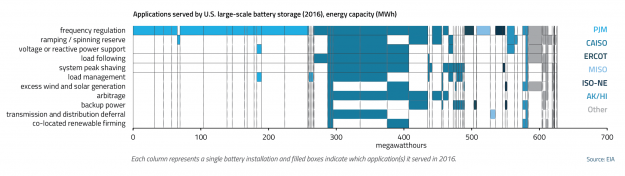
States Make Strides in Setting Pay Outs for Battery Storage, Opening Door to Growth

EnerKnol’s Visual Primer – States Make Strides in Setting Pay Outs for Battery Storage, Opening Door to Growth

U.S. states are plowing ahead in setting market compensation rules for battery technology, laying the foundation for future growth of the fast-maturing technology in retail and wholesale markets. While progressive states California, New York and Massachusetts are charging ahead in how to value the resource, others are still grappling with how to regulate a system that fails to fit squarely in any one box and that raises a range of jurisdictional and ownership questions.