

Federal Policy Shifts Slow Coal Plant Retirements Amid Grid Reliability Concerns: EIA
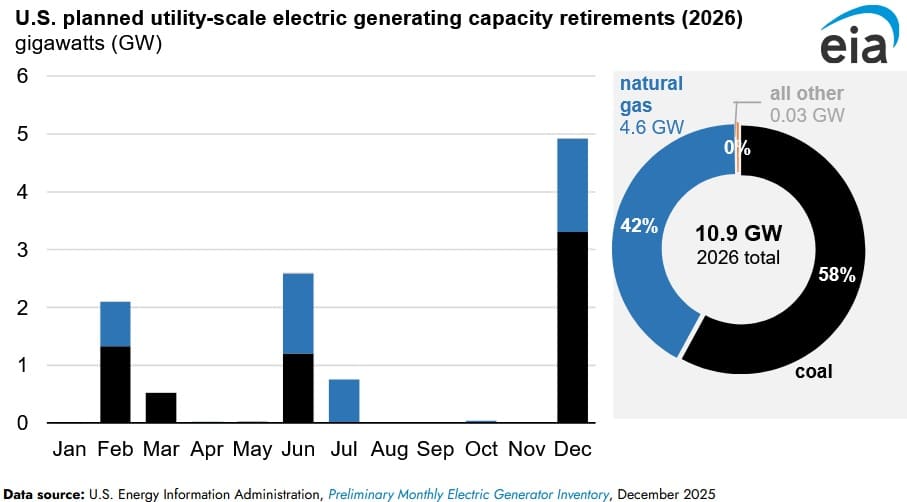
The U.S. Energy Information Administration on Feb. 23 reported that power plant owners and operators planned to retire nearly 11 gigawatts of utility-scale generating capacity in 2026, but recent federal reliability actions have already delayed several closures and could continue to reshape the timeline. Coal-fired plants and older natural gas units account for almost all planned retirements, yet emergency orders issued in 2025 to keep certain facilities operating underscore growing concerns about maintaining grid reliability during the energy transition.
Coal units represent about 6.4 gigawatts of planned retirements this year, equal to nearly 4 percent of the coal fleet operating at the end of 2025. Retirement plans slowed sharply last year when emergency orders from the U.S. Energy Department allowed several large plants to remain online to support reliability, resulting in only a fraction of anticipated coal closures. Units postponed into 2026 include the 1,331-megawatt J.H. Campbell plant in Michigan, South Oak Creek Units 7 and 8 in Wisconsin, R.M. Schahfer Units 17 and 18 in Indiana, Craig Station Unit 1 and Comanche Unit 2 in Colorado, and F.B. Culley Unit 2 in Indiana. The largest closures now expected this year include J.H. Campbell and Cumberland Unit 2 in Tennessee, though additional federal action could again alter schedules.
Natural gas plant retirements are projected at 4.6 gigawatts, about 1 percent of the operating fleet, with most closures involving aging steam turbine units that are less efficient than modern combined cycle facilities. In California, AES Alamitos and Huntington Beach units totaling 1,368 megawatts are slated to retire after multiple delays tied to reliability needs, with newer combined cycle plants replacing their output. Additional retirements include Elwood Energy Units 1 through 7 in Illinois, Sabine Units 1, 3, and 4 in Texas, and Eddystone Units 3 and 4 in Pennsylvania, the latter deferred following a federal emergency order.
The agency indicated that rising electricity demand, replacement capacity timing, and potential reliability directives could continue to delay plant closures, highlighting how federal intervention is increasingly shaping the pace of retirements and the broader shift toward cleaner generation.
EnerKnol Pulses like this one are powered by the EnerKnol Platform—the first comprehensive database for real-time energy policy tracking. Sign up for a free trial below for access to key regulatory data and deep industry insights across the energy spectrum.
ACCESS FREE TRIAL