

U.S. Crude Oil and Natural Gas Production Growth to Remain Strong Through 2030: EIA
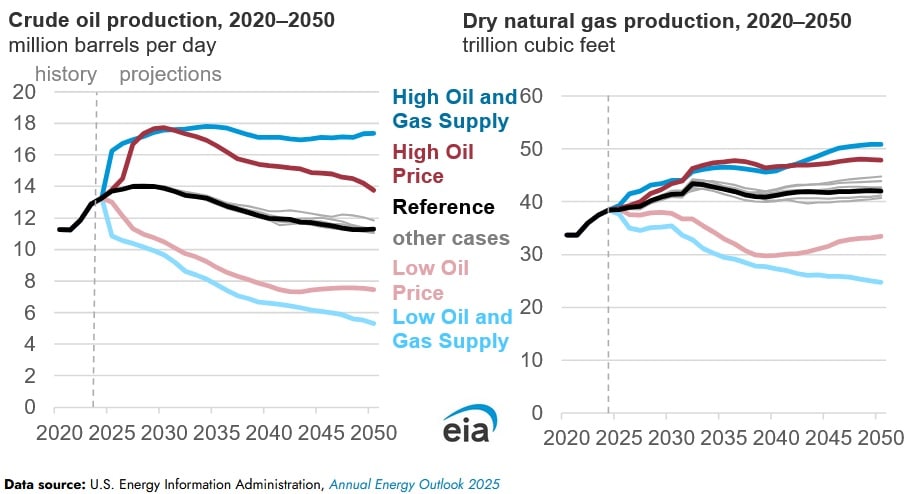
U.S. crude oil and natural gas production growth is projected to remain relatively high through 2030, according to a July 11 report by the U.S. Energy Information Administration. This growth is largely driven by rising exports of petroleum products and liquefied natural gas (LNG). Advances in drilling technologies, particularly horizontal drilling and hydraulic fracturing, have also played a key role in increasing production. U.S. exports continue to be financially attractive in international markets.
Crude oil production is forecast to increase to around 14 million barrels per day (b/d) during 2027 or 2028, up by 0.8 million b/d compared to 2024. The increase in crude oil production can be attributed to increased productivity, amid technological advancements and increased efficiency. Majority of the production increase is expected from the Permian region. Oil companies are increasingly leveraging technological enhancements, including electronic hydraulic fracturing technologies, artificial intelligence and automated drilling procedures, to improve operations while operating fewer rigs. This alteration towards digital solutions has enhanced completion and drilling techniques and shortened rig downtime, and it offers innovative analytics to help target forthcoming operations. These technological innovations and results have permitted producers to elevate production rates for rigs as they drill new wells.
Crude oil production is forecast to increase to around 18 million b/d in the early 2030’s, thereafter crude oil production begins to decline, in line with projections of lower domestic petroleum demand. The decline in well productivity—partially attributable to diminished output resulting from the closer spacing of wells—has reduced the economic viability of drilling in certain regions.
Dry natural gas production is projected to rise between 42.6 trillion cubic feet (Tcf) and 44.3 Tcf during the early 2030s, compared to 38.4 Tcf in 2024. Oil and natural gas production volumes in the U.S. continue to support increased exports of both petroleum products and natural gas. The majority of domestically produced crude oil is refined within the country into petroleum products, which are subsequently exported. According to the agency’s projections, the U.S. is projected to remain a net exporter of petroleum products through 2050, supported by anticipated capacity expansions at export terminals that will enable natural gas processors and refineries to scale up exports.
U.S. natural gas prices generally remain below those of international markets, enhancing the competitiveness of U.S.-sourced LNG globally. As a result of these favorable market conditions, the agency forecasts sustained growth in LNG exports through 2040.
EnerKnol Pulses like this one are powered by the EnerKnol Platform—the first comprehensive database for real-time energy policy tracking. Sign up for a free trial below for access to key regulatory data and deep industry insights across the energy spectrum.
ACCESS FREE TRIAL