As Environmental, Social, and Governance (ESG) awareness sweeps boardrooms around the world, procurement managers are forced to examine the business practices and environmental stewardship of their…Read the full report …...
As Environmental, Social, and Governance (ESG) awareness sweeps boardrooms around the world, procurement managers are forced to examine the business practices and environmental stewardship of their supply chain.
The ongoing conversation on the role of natural gas utilities in reducing emissions continues as utilities work towards achieving ambitious state decarbonization goals.
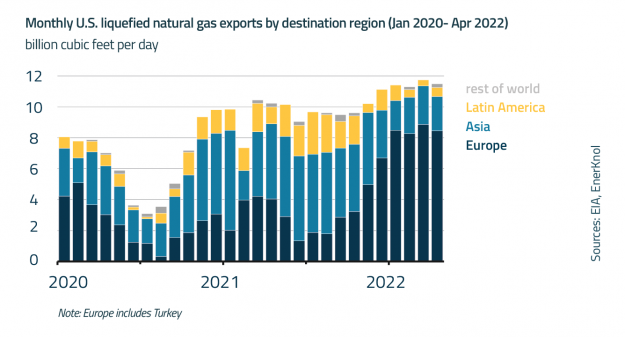
The U.S. liquefied natural gas (LNG) sector is poised for more growth amid surging natural gas prices, growing export capacity, and high demand due to Europe's supply crisis. Currently, about 25 LNG projects are under construction or under different stages of planning across the country.
The U.S. Energy Department’s $6 billion nuclear credit program, the pursuit for carbon-free generation to meet climate goals, and technological advancements are reigniting support for nuclear power. The global impact of Russia’s war on Ukraine has also escalated the importance of national security considerations in energy policies including a discussion about the role of nuclear power.
Several states that have ambitious clean energy and emissions reduction mandates are investigating the role of natural gas in the shift to a low-carbon power system. Actions at the federal level, spurred by the Biden administration’s goal of net-zero emissions by 2050, are also catalyzing efforts to decarbonize the gas system.
Russia’s attack on Ukraine has roiled global markets, causing oil prices to soar at a time when the world is recovering from the economic fallout of the COVID-19 pandemic. The conflict, entangled with the global energy crisis, has been met with heavy economic sanctions from the U.S. and most European countries. Companies across the oil and gas value chain have also announced plans to abandon investments in Russia.
The Biden administration is walking a tightrope on climate action as recent moves in the oil and gas industry challenge its aggressive climate agenda, which calls for net-zero emissions by 2050.
U.S. President Joe Biden signed the Infrastructure Investment and Jobs Act into law on Nov.15, unlocking $62 billion for U.S. Energy Department initiatives, including revitalizing domestic manufacturing, expanding access to energy efficiency and clean energy, modernizing the power grid, and advancing next-generation technologies. Among the major provisions, the legislation allocates $6 billion for a Civilian…...
Eastern Gas Transmission and Storage Inc. (EGTS), which provides natural gas transportation and storage services with one of the largest underground natural gas storage systems in the U.S., has requested a whopping 214 percent increase in cost of service rates in its first general rate case filed with federal regulators since 1998. The proposed changes have drawn protests from over two dozen companies that rely on the EGTS system for transportation and storage services.
The Mississippi Public Service Commission approved the construction of a 200-megawatt wind turbine electric generation facility in Tunica County. The project will be developed by Tunica Wind Power LLC, whose parent company is Vestas—a company based in Denmark, that designs, installs, and services wind turbines having more than 132 GW of wind turbines in 83…...
Ongoing state initiatives to transition to a low-carbon future and new actions from the federal level are impacting natural gas utilities’ long-term planning strategies. The challenge for utilities is to adapt to the changing policy landscape, evolving in ways that contribute to decarbonization.